On October 2, 2025 I gave a guest lecture at MIT in 18.642, Topics in Mathematics with Applications in Finance, on where the hedge fund world is heading. This post is a written version of that talk.
The argument is that two trends are reshaping the industry, and that both are downstream of ideas that are decades old:
- Unbundling. Parts of the hedge fund workflow are moving outside the firm, to crowds of data scientists coordinated by competitions and, in some cases, blockchain-based incentives.
- Human + machine collaboration. The evidence is now fairly clear that combining human forecasts with machine forecasts beats either alone. Perhaps in the future, machines alone will suffice, but today, humans are still adding value.
Background and theory
Almost everything interesting about these trends follows from a handful of results in statistics, machine learning, and social science.
Condorcet's jury theorem (1785). Machine learning started in...1785. If each juror is right with probability greater than one half, and errors are independent, the probability that the majority is correct goes to one as the number of jurors grows:
The catch is in the fine print. Independence and diversity of errors matter. A thousand copies of the same model is one juror.
Boosting (1988) and stacking (1992). Kearns asked whether weak learners could be combined into a strong one, and Friedman's gradient boosting machine made that practical. Boosting fits models sequentially, each one to the residual errors of the ensemble so far:
Wolpert's stacked generalization went the other way. Train diverse base models independently, collect their out-of-fold predictions, and fit a meta-model on top:
Model averaging is just stacking where is a weighted sum. Gradient boosted trees remain the dominant approach for tabular data, and, often together with stacking, are how nearly every classic tabular Kaggle competition was won.
The Dunbar number (1992). Dunbar estimated that humans can maintain roughly 150 stable relationships. Past that, organizations fracture into silos and lean on process. This is a constraint on how a firm built on trust can grow.
Wisdom of crowds (2004). Surowiecki's conditions for a crowd to beat its experts: diversity of opinion, independence, decentralization, and a mechanism for aggregation. Note how closely this mirrors the conditions for an ensemble to work.
The common task framework (2007 onward). Donoho's name for the recipe that drove the machine learning boom: a clear task, a shared dataset with hidden test labels, an evaluation metric, and an open competition. The Netflix Prize, Kaggle, and ImageNet are all instances. It turns out to be an extraordinarily efficient way to extract predictive power from a large group of strangers.
Machine, platform, crowd (2017). McAfee and Brynjolfsson tie the above together for business. This book has been very influential on my thinking. Crowds beat experts, platforms unlock assets that were previously stranded, trust can be built through leaderboards and ratings, and success is a function of incentives and governance.
Takeaways: ensembles work, competitions scale, and social science has a lot to say about how to design the organizations and incentives that harness collective intelligence.
The traditional hedge fund
How does a hedge fund scale without breaking? Mostly by respecting Dunbar. The multi-manager platform does it with pods: small teams, central risk. The lean fund does it by capping its own organization size. The bureaucratic fund does it with heavy process. And the quant fund does it by structuring itself as an assembly line.
I wrote up that assembly line in 2016 as A Professional Quant Equity Workflow. Separate teams own separate stages:
- Data acquisition
- Alpha research, which is feature engineering by another name
- Signal combination, which is modeling
- Risk and transaction cost modeling
- Portfolio construction, which is optimization
- Execution
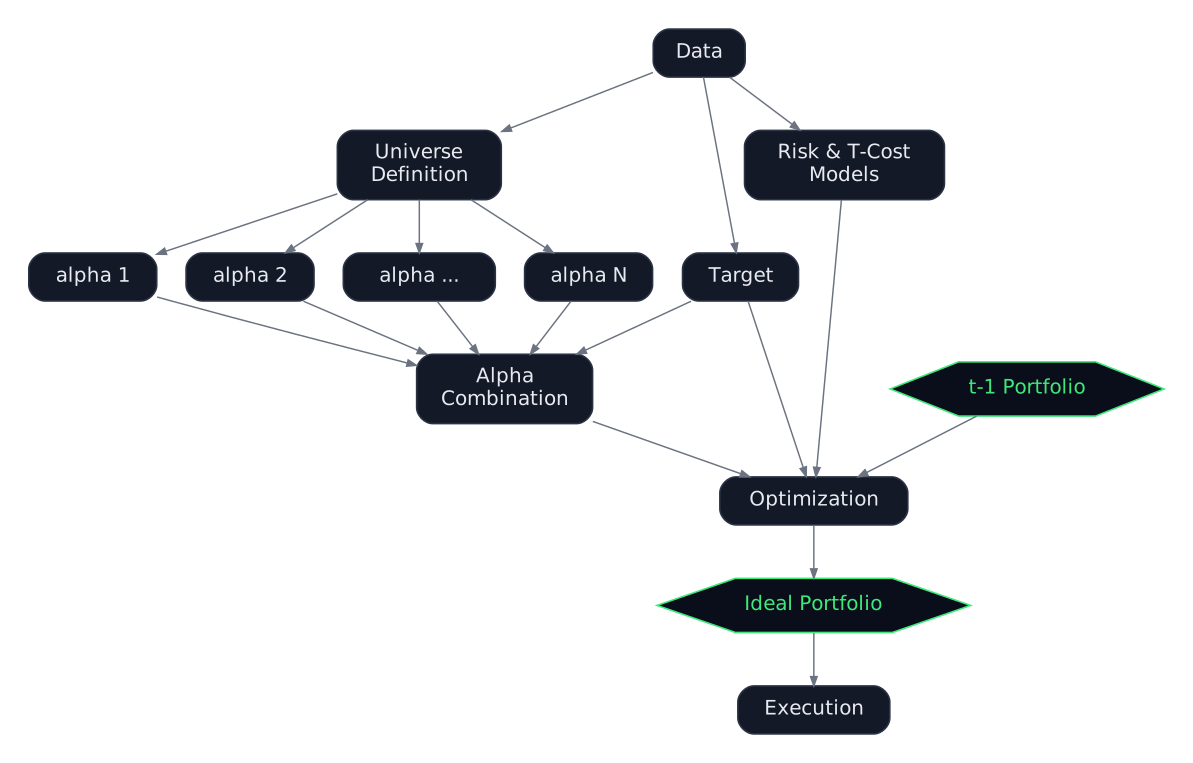
The 2017 Wall Street Journal piece on WorldQuant's "alpha factory," with 125 PhDs across 15 countries, is this workflow at industrial scale. Alphas are produced upstream, combined in the middle, and optimized and executed downstream. The important point for what follows is that the stages are separable. Once you can describe the interface between them, you can imagine moving one of them outside the building.
Unbundling
That is exactly what the decentralized hedge funds do. Part of the workflow, usually alpha research and signal combination, is pushed out to a global crowd, coordinated by a competition and often paid in a token. Four examples, as of October 2025.
Numerai (San Francisco, 2015) runs weekly tournaments on anonymized, obfuscated market data. Participants submit predictions, are scored on correlation with realized returns, and stake the NMR token on their own models. Accurate models earn, inaccurate ones are burned. The firm builds a stake-weighted meta-model from the community's submissions and trades it. The crowd generates intelligence; the company curates data, runs the fund, and executes.
Yiedl (Italy, 2023) takes the idea fully on-chain. It is a DAO rather than a company, running weekly tournaments on 75 crypto assets, with predictions encrypted to IPFS, smart contracts that reward and penalize automatically, and vaults on Optimism and Synthetix that execute the resulting strategies. Token holders govern it. There is no general partner.
CrunchDAO (Paris, Dubai, New York, 2021) is a decentralized data science collective rather than a fund. Over 5,000 contributors, including roughly 600 PhDs, compete on anonymized datasets with code submissions run in controlled environments and compute quotas for fairness. Some challenges are financial, such as the DataCrunch equity market neutral challenge and the ADIA Lab structural break challenge, and the aggregated consensus signals are licensed to institutional clients. Prizes are paid in USDC today; a native CRUNCH token is planned.
CrowdCent combines fundamental analysts with machine learning. Analysts share written fundamental investment theses through SumZero, internal data scientists build models on those ideas plus market data, and a community of data scientists competes in challenges such as ranking Hyperliquid assets by forward returns. There is no native token, but the firm runs a vehicle that stakes within Numerai's ecosystem, bridging decentralized funds together.
The common threads are community-driven intelligence, machine learning as the aggregation mechanism, and crypto as both incentive and settlement infrastructure. Whether every one of these survives is beside the point. The pattern is the same one that produced Kaggle, applied to the alpha research stage of the workflow.
Human + machine collaboration

The second trend is quieter but well evidenced. There are two shapes collaboration can take.
Horizontal. Treat the human forecast as one more feature. Concatenate it with the machine's inputs and fit a model on both.
Cao, Jiang, Wang, and Yang (Journal of Financial Economics, 2024) do this at scale. Their human forecasts are 948,054 twelve-month price targets from 11,341 analysts on 6,190 firms, 2001 to 2018. The machine is an ensemble of random forests, boosting, and LSTMs trained on fundamentals, 10-K and 10-Q text, and macro series, with analyst forecasts deliberately excluded. The machine alone beats the analyst 54% of the time. The machine with the analyst's forecast included as a feature beats the analyst 57% of the time. The human forecast carries information the machine cannot recover from public data on its own.
Vertical. Stepwise. Human first, machine second (or the reverse). The human generates ideas and the machine filters, ranks, or optimizes.
deHaan, Lee, Liu, and Noh (Stanford GSB, 2025) construct 170 alphas from public data and fit a random forest to forecast one-quarter-ahead DGTW-adjusted returns. The "human" portfolios are the 13-F holdings of 3,337 active US equity mutual funds from 1990 to 2020. The AI analyst then adjusts each manager's portfolio within its own style group:
- Keep the manager's picks that the model places in the top decile.
- For picks in deciles one through nine, swap into the best available top-decile name from the same style group, subject to a liquidity cap.
- Drop anything left in the bottom decile and replace it with the group's style index, so the portfolio stays in-style.
- Renormalize.
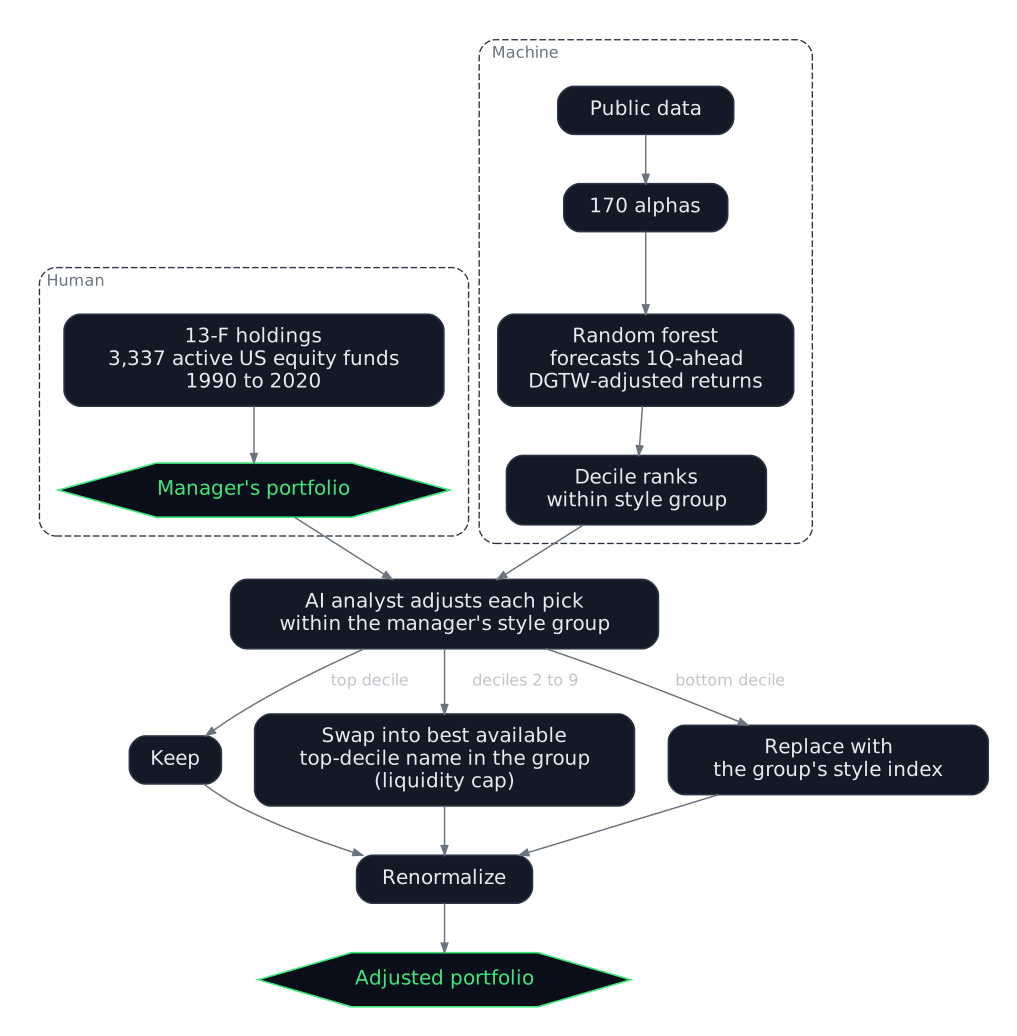
The average human Sharpe is about 0.47. The average paired improvement from the AI adjustment is about 0.17, with a t-statistic near 69, and roughly 95% of funds improve. That holds net of transaction costs, and under a conservative payout convention where the AI's incremental gains are paid out each quarter so it never compounds an AUM advantage. A random forest on public data, sitting downstream of a human stock picker, adds meaningful risk-adjusted return to nearly every fund in the sample.
Conclusions
- Ensemble methods are the workhorse of applied machine learning, and their conditions for success are the same as the conditions for a crowd to be wise.
- The common task framework drove progress in AI, and it is now being applied to the alpha research stage of the hedge fund workflow.
- Social science has concrete guidance on how to design incentives and governance for collective intelligence, and the decentralized funds are running that experiment in public.
- Hedge funds are unbundling, with crowdsourcing and crypto incentives moving pieces of the workflow outside the firm.
- Human plus machine beats either alone, in both the horizontal and the vertical configuration, and the evidence is from large samples.
References
- Cao, S., Jiang, W., Wang, J., and Yang, B. "From Man vs. Machine to Man + Machine: The Art and AI of Stock Analyses." Journal of Financial Economics 160, 2024. papers.ssrn.com
- Condorcet, M. de. Essai sur l'application de l'analyse à la probabilité des décisions rendues à la pluralité des voix. Imprimerie Royale, 1785.
- deHaan, E., Lee, C., Liu, M., and Noh, S. "The Shadow Price of 'Public' Information." Working paper, Stanford Graduate School of Business, 2025. gsb-faculty.stanford.edu
- Donoho, D. "50 Years of Data Science." Journal of Computational and Graphical Statistics 26(4), 2017. stat.berkeley.edu
- Dunbar, R. I. M. "Neocortex Size as a Constraint on Group Size in Primates." Journal of Human Evolution 22(6), 1992.
- Friedman, J. H. "Greedy Function Approximation: A Gradient Boosting Machine." Annals of Statistics 29(5), 2001.
- Hope, B. "With 125 Ph.D.s in 15 Countries, a Quant 'Alpha Factory' Hunts for Investing Edge." Wall Street Journal, April 2017.
- Kearns, M. "Thoughts on Hypothesis Boosting." Unpublished manuscript, 1988.
- Larkin, J. A Professional Quant Equity Workflow. Lecture notes, 2016. github.com/marketneutral/lectures
- Larkin, J. The Evolution of the Hedge Fund. Guest lecture, MIT 18.642, October 2025. marketneutral.github.io/hedge_fund_evolution
- McAfee, A. and Brynjolfsson, E. Machine, Platform, Crowd: Harnessing Our Digital Future. W. W. Norton, 2017.
- Surowiecki, J. The Wisdom of Crowds. Doubleday, 2004.
- Wolpert, D. H. "Stacked Generalization." Neural Networks 5(2), 1992.