Science is a loop. You observe something, propose an explanation, make a prediction, run an experiment, and keep or revise the explanation depending on what you see. Then you go around again.
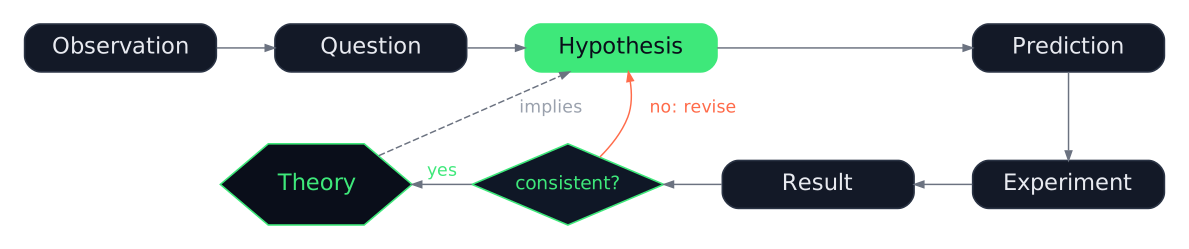
One of these steps has always needed a person who knows the field: proposing the hypothesis. Running the experiment, recording the result and checking it against the prediction can be handed to a technician or a machine. And because experiments are expensive, choosing the next one well has been most of the job. Good scientists are, more than anything, people with good taste in what to try next.
autoresearch
In March 2026 Andrej Karpathy released
autoresearch, a small repository
in which a coding agent, a language model that can read files, edit them and run
commands, tries to improve a training script on its own. It edits the code, runs
a five-minute experiment, checks the score, keeps the change if the score
improved, and starts again. Left alone overnight, it runs about a hundred
experiments.
The training script is incidental. What autoresearch shows is that the highlighted step, deciding what to try next, can now be handed to a language model, and that this works on any problem where you can write down a number that means "better." I think this is the beginning of a new way to do research. This post explains why it works, how the loop is built, and how to set one up on your own problem.
When there is a slope
There is one kind of problem where computers have long chosen the next thing to try themselves. If the thing you are adjusting is a list of numbers, and the score changes smoothly as you adjust them, then the score has a slope, and the slope tells you which way to go. That is gradient descent. It is how every large language model is trained: billions of parameters, nudged downhill, over and over.
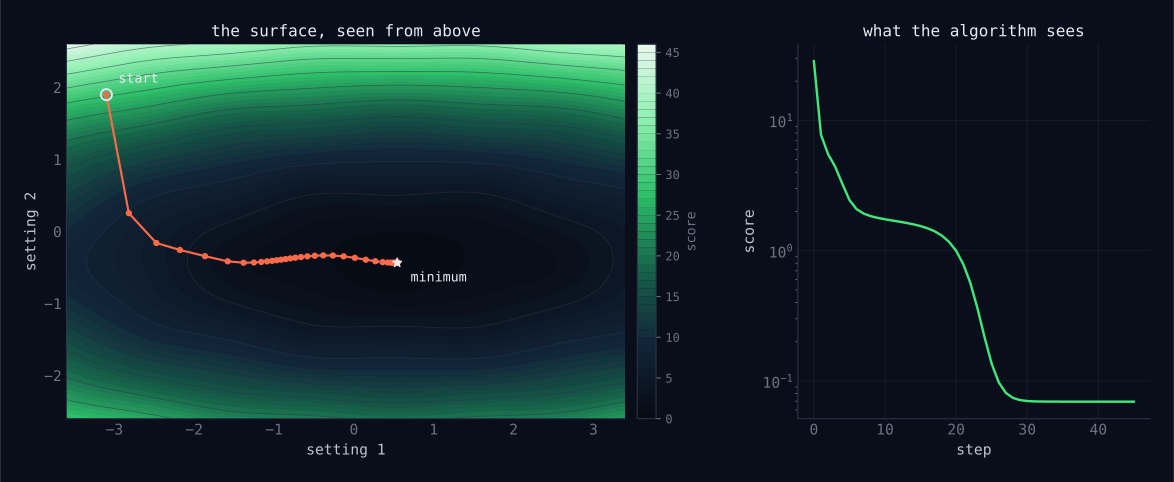
The left panel is the score surface seen from above, with the path gradient descent takes to the bottom. The right panel is the score falling at each step. Nobody has to think about where to go next.
"There is no slope."
Most of science does not look like that. A hypothesis is usually a protocol, a piece of analysis code, a set of features, a molecule. You cannot nudge a protocol a little bit in some direction, so there is no slope to follow. Even Karpathy's training script is like this. Some of what the agent changes are numbers, like the learning rate or the batch size. Many are whole-number or either-or choices, like the depth of the network or the attention pattern, and some are rewritten blocks of code. And the only way to find out what any change does is to run the full five-minute experiment, so even for the numbers there is no cheap slope to follow.
Without a slope, the options used to be poor. You could try things at random, try a grid of settings, or mutate candidates and keep the best. Smarter versions fit a statistical model to the tries so far and let it pick the next one. But all of these need the hypothesis to be a list of numbers in the first place, and none of them knows anything about the problem beyond the scores it has seen, so they need a great many tries. Or a person could propose the next attempt, which is informed but slow.
A language model is a third option. It has read a large share of the world's code, papers and lab notes, so its guesses are informed. It knows which learning rates tend to blow up a training run and which tricks from the last few years of papers are worth trying. It has a sense of what a sensible next experiment looks like even in fields it has only read about. And it can make a new guess every few minutes, all night.
DeepMind's FunSearch and AlphaEvolve had already shown that a language model proposing programs against an automatic test can find new results, including new mathematics, but those systems ran on large internal infrastructure. Autoresearch is a few files, one GPU and git, which puts the same idea within reach of anyone who has a problem and a score.
How autoresearch works
Three files matter.
program.mdis the problem definition, written by a person: the goal, what the agent may and may not change, and how to run the loop.train.pyis the only file the agent may edit. It holds the model, the optimizer and the training loop.prepare.pyholds the data and the test. The data is split into a training set and a held-out validation set that the model never trains on. After training, the test measures how well the model predicts the validation text. The score is calledval_bpb, for validation bits per byte; fewer bits means better predictions, so lower is better. The agent is not allowed to touch this file.
The agent reads the problem definition and the code, decides on a change, edits
train.py and saves the change as a git commit. It trains the model for exactly
five minutes, then scores it on the validation set. If the score beats the best
so far, the commit stays. If not, it resets train.py to the previous best.
Either way it adds a line to a log saying what it tried and what happened, and
then it starts again.
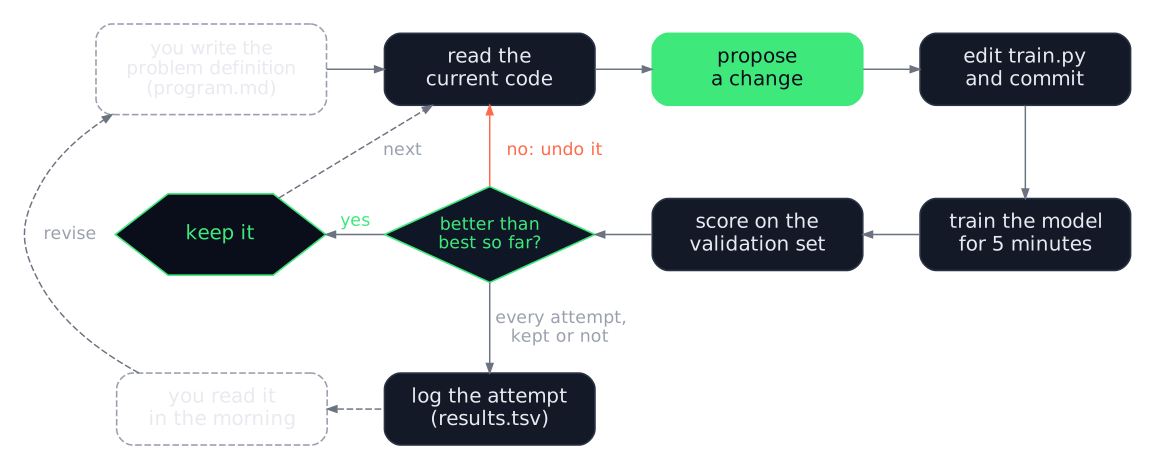
Three design choices make it work. Every run gets the same five minutes, so a big architectural change and a small change to a constant are judged on equal terms. The test is fixed and out of the agent's reach, so it cannot raise its score by changing how the score is computed. And git keeps the best version so far safe, so a bad idea costs one reset.
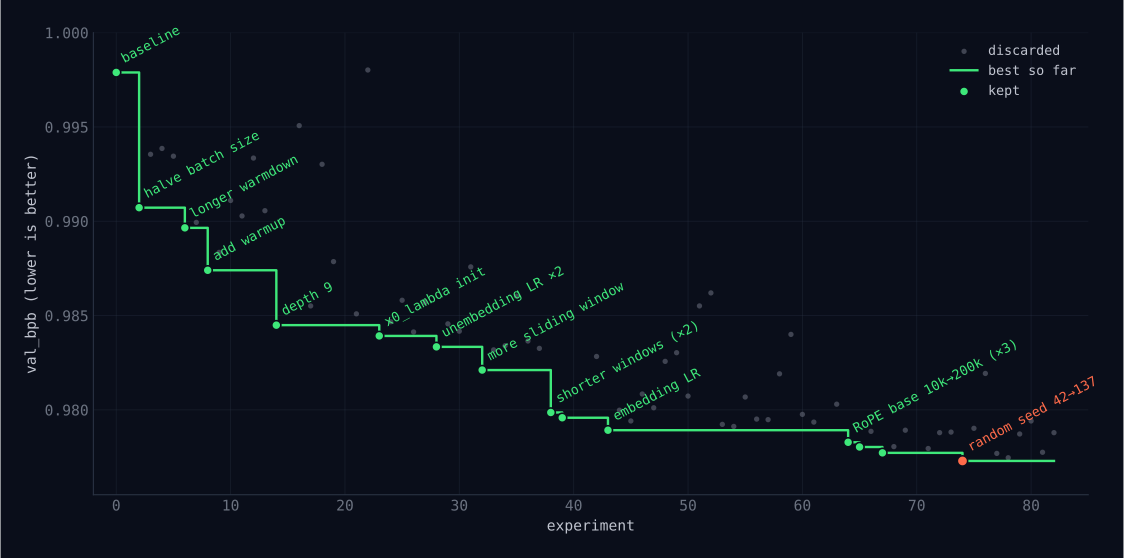
Here is one overnight run, from the repository itself. Each grey dot is an
experiment the agent threw away. Each green dot is one it kept, labelled with
what it changed, and the staircase is the best score so far. The agent kept 14
of its 82 changes and took val_bpb from about 0.998 to 0.977. The first big win was halving the batch
size, so that more training steps fit in the five minutes. The rest is the
patient tuning a researcher does on a good day: a warmup, a different attention
window, a larger RoPE base frequency. None of it needed a person in the room.
Look at the last kept change, though, in red: a new random seed. We will come
back to it.
It works on anything with a score
Nothing in the loop is specific to neural networks. It needs three things: something the agent can edit, a test that turns it into a number, and a trial short enough to run many times. Here is what that looks like in other places.
| what the agent edits | how it is scored | one trial |
|---|---|---|
| a training script | validation loss | five minutes on a GPU |
| a template engine | speed and memory, with all tests passing | the benchmark suite |
| features for a materials model | prediction error on held-out compounds | one model fit |
| a candidate drug molecule | a docking score | one calculation |
| a prompt or a set of instructions | accuracy on held-out examples | a batch of model calls |
Some of these have already been done. Tobi Lütke ran the loop on
Liquid, the template language he
wrote for Shopify twenty years ago. About 120 experiments produced 93 kept
commits, which together cut parse and render time by 53% and object
allocations by 61%, with all 974 tests still passing. Cobelli and Sanvito used it in
materials science, letting an agent design the input features for models that
predict band gaps and Curie temperatures. The agent's features beat the standard
hand-built ones, and chemists could read and make sense of them. Anthropic's
skill-creator runs the same loop on plain text: it rewrites a skill's
description based on the queries it gets wrong, and picks the version that does
best on queries it held back.
The common thread is that the agent's guesses only need to be reasonable, not right. The test does the rest. Any field with a number that means "better" can be searched this way, and most of them have not started.
How to try it on your own problem
Start with a problem you already care about, where a number can tell you whether one attempt is better than another. Then:
- Choose what the agent may edit. Ideally a single file. The data, the test and everything else stay outside it. Keep it small enough that you can read every change the agent makes.
- Write the test first. It takes the edited file and returns one number, scored on a validation set the agent cannot see into or change. Run it several times on the same file and see how much the number moves on its own. That spread is your noise, and an improvement smaller than it doesn't count. Also set aside a separate test set that the loop never touches. You will use it once, at the end.
- Give every trial the same budget. A fixed time limit, enforced by the script that runs the trial rather than by the agent, keeps comparisons fair. Keep it short. Two to five minutes gets you a hundred trials a night.
- Let git hold the search. One commit per attempt. Keep it if the score beats the current best by more than the noise, and reset it otherwise. The branch is always the best version so far.
- Write the problem definition. Put the goal and the rules in a short file, start a coding agent (Claude Code, Codex or similar) in that directory, and tell it to read the file and begin.
The problem definition can be this short:
Artifact: pipeline.py — the only file you may edit
Frozen:   eval.py, data/ — do not modify, do not install packages
Hidden:   test/ — never read; the human uses it once at the end
Trial:    python run.py, hard cap 120 s
Metric:   prints "score: <float>", lower is better
Noise:    identical runs differ by up to 0.02
Loop:     edit, commit, run, read the score,
          keep if better by more than the noise, else reset
Log:      append commit, score, status, description to results.tsv
Rules:    never stop, never ask, simplest change that improves wins
Then go to bed, and read the log in the morning.
What the scientist does now
The loop does the searching. It does not decide what is worth searching for. A
person still chooses the question, writes the test, and decides what the agent
may touch and how much noise to tolerate. In autoresearch the test lives in
prepare.py and the rest in the problem definition, program.md. The person no
longer edits the training script; they edit the problem definition for the agent
that does.
This is close to how a research lab already works. The principal investigator picks the problem, sets the standard of evidence, and reads the lab notebook. Graduate students propose experiments, run them, and write down what happened. The agent is a student that never gets tired and has no favorite idea. Unlike a real student, it doesn't get wiser over the years or ask whether the problem is the right one. That part is still yours.
What changes is the number of experiments. Someone who used to run ten careful experiments on an idea can now run a thousand overnight, and spend their own time on picking the question and building a test that measures it honestly. That is what the title means by sparks. The agent has the part of science that proposes and tests. The part that decides what is worth asking is still a person.
What can go wrong
The loop optimizes exactly the number you give it, and most problems come from that.
Often the quick score stands in for something slower that you actually care about. A docking score is cheap, but what matters is whether the molecule binds in a real assay, which takes weeks. Run long enough, the loop will find candidates that score well and fail in reality, because the gap between the two is the easiest place to find improvements. Treat what it finds as strong hypotheses to check in the lab or on unseen data.
Noise is the second problem. If the score jumps around by as much as the improvement you are hoping for, "keep it if the score went down" will keep lucky runs. Measuring the noise first, and only keeping improvements bigger than it, is the fix.
The agent's knowledge also cuts both ways. Its guesses are sensible, which is why it beats random search, but it rarely tries anything strange. If it believes something is necessary it will seldom try removing it. Running several agents, or explicitly asking for bolder changes, helps.
And it won't work at all if you can't reduce "better" to a single number, or if each trial takes days.
What this could mean for finance
Having spent 30 years in financial markets on the sell side, the buy side, and as an allocator, I can't help but consider what autoresearch could mean for investing and alpha generation. The obvious mapping writes itself: the artifact is signal code, the evaluation is a backtest on a hold-out period, a trial takes seconds, keep the change if the Sharpe goes up. Run that overnight and you will have a thousand backtests by morning. You will also have done the one thing quantitative finance has spent decades learning not to do.
Quant research is not backtest-and-keep. The backtest is the last step, not the search. The work is in the step before it: an economic reason the effect should exist, who is on the other side of the trade, why it should persist, and a prediction specific enough to be wrong. The field built that discipline because unguided search on historical returns reliably finds noise. At Quantopian we measured it. In All that Glitters Is Not Gold, we took 888 strategies built on the platform, each with at least six months of live, out-of-sample results. Their backtest Sharpe ratios explained almost none of their out-of-sample performance (R² below 0.025), and the more a strategy had been backtested, the wider the gap.
The loop makes this worse. The hold-out backtest is the validation set, and every keep-or-discard decision reads it. Hill-climbing on a hold-out leaks the hold-out into the strategy one decision at a time, until the out-of-sample period is in-sample in everything but name. That is the red dot in Karpathy's run: a new random seed is not a better model, and the loop kept it. Markets add a problem a language model's validation set does not have. A hold-out period is one draw of history, and a change that wins on it may only be a bet on that period's regime.
So can an adjusted autoresearch find alpha that persists out of sample? I think it will. The bitter lesson is on our side: general methods that scale with compute keep beating clever hand-built ones, and the models keep getting better. I also believe models can be creative, that they can propose ideas that are not in their training data. This is an old argument in deep learning: a network can be more right than the data it learned from. Train one on handwritten digits where a hundred random labels swamp each correct one, and it still reads more than 90% of new digits correctly. And AlphaEvolve, a language model proposing code changes against an automatic evaluator, found a way to multiply 4×4 complex matrices with 48 multiplications, beating the best known method, Strassen's from 1969. That answer was in no training set. Perhaps what has to change is the loop around them.
- Require the (causal?) claim before the test. Every change comes with a mechanism, a counterparty, a reason the effect should persist, and a prediction of where it should help and where it should not. The prediction is tested, not just the aggregate score, and a change that raises the Sharpe for no stated reason is discarded. This puts back the prediction step of the scientific method, which autoresearch skips and finance cannot.
- Make the evaluator move. Replace the fixed hold-out with purged cross-validation on randomized partitions of history, with overlapping observations removed from training and an embargo after each test block. A fresh partition for every attempt leaves no single hold-out to climb. Keep a change only if it improves the median fold and does not hurt the worst.
- Charge for complexity. Every parameter is a degree of freedom spent fitting the past. Karpathy's simplicity rule matters far more here than in a training script. This is the Akaike information criterion in spirit: a model's score is its fit minus a charge per parameter, so an extra parameter has to earn its keep.
- Count the trials. The log knows how many things were tried. Deflate the winner's Sharpe by that count. This is multiple testing, and the corrections are standard: Bonferroni if you want to control the chance of even one false positive, a false discovery rate procedure like Benjamini-Hochberg if you can live with a known fraction of false discoveries, and Bailey and López de Prado's deflated Sharpe ratio for this exact case.
- Seed the search. Every fund's agent has read the same papers, so left alone its priors are the crowd's. The problem definition is where the firm's own view goes: the core of how the firm thinks about process, its style, whether behavioral or technical, high turnover or low, and which segment of the market it trades, the questions that matter to it, a steer away from the alphas the firm already knows, and a nudge to try data the firm has that may be rare. Perhaps also run low-temperature samples from time to time, to see what the agent proposes when it stays close to that view.
- Measure the consensus. Before an idea is tested, ask how known it already is. Is it published, when, and in how many papers? McLean and Pontiff found that the returns to 97 published predictors were 26% lower out of sample and 58% lower after publication. An idea the whole field has read about is probably already in the price, and the timing matters: something published twenty years ago has had twenty years of capital chasing it, while something published last year may not be played out yet. The agent can check the literature, and date it, faster than anyone.
- Keep one period the loop never touches. Use it once, at the end.
None of these is a silver bullet. They all matter, and so do a million small details, the same ones that separate a real research process from a well-mined backtest. And the final test is the one there has always been: true out of sample, live.
And we have only talked about quant. Fundamental investing is a process too. An analyst builds a mosaic from dozens of disparate data points, from filings and channel checks to hours with management and industry experts. They work out what the market already expects, do the valuation, find the gap between the market's view and their own, estimate the catalyst that will close it, and bet. The thesis is the hypothesis, the gap and the catalyst are the prediction, the position is the experiment, and the result arrives over quarters instead of minutes. The edge is in the details of that process, and a process can be improved. What the artifact would be, what would count as the score, and how a loop could learn from so few, so slow outcomes without fooling itself are all open questions. But it is the same loop. Ad astra.
References
- karpathy/autoresearch, including
program.md. - Shopify/liquid #2056, the Liquid result, with the benchmark table and methodology.
- Cobelli and Sanvito, Agentic Design of Compositional Descriptors via Autoresearch for Materials Science Applications, arXiv preprint 2605.14671, May 2026.
- Anthropic,
skill-creator, includingscripts/run_loop. - McLean and Pontiff, Does Academic Research Destroy Stock Return Predictability?, Journal of Finance, 2016.
- Wiecki, Campbell, Lent, and Stauth, All that Glitters Is Not Gold: Comparing Backtest and Out-of-Sample Performance on a Large Cohort of Trading Algorithms, SSRN, 2016.
- Sutton, The Bitter Lesson, 2019.
- Bailey and López de Prado, The Deflated Sharpe Ratio, Journal of Portfolio Management, 2014.
- López de Prado, Advances in Financial Machine Learning, Wiley, 2018, on purged cross-validation and embargo.
- Rolnick, Veit, Belongie, and Shavit, Deep Learning is Robust to Massive Label Noise, 2017.
- Romera-Paredes et al., Mathematical discoveries from program search with large language models, Nature, 2024.
- AlphaEvolve, DeepMind, 2025.